A platform taking shape
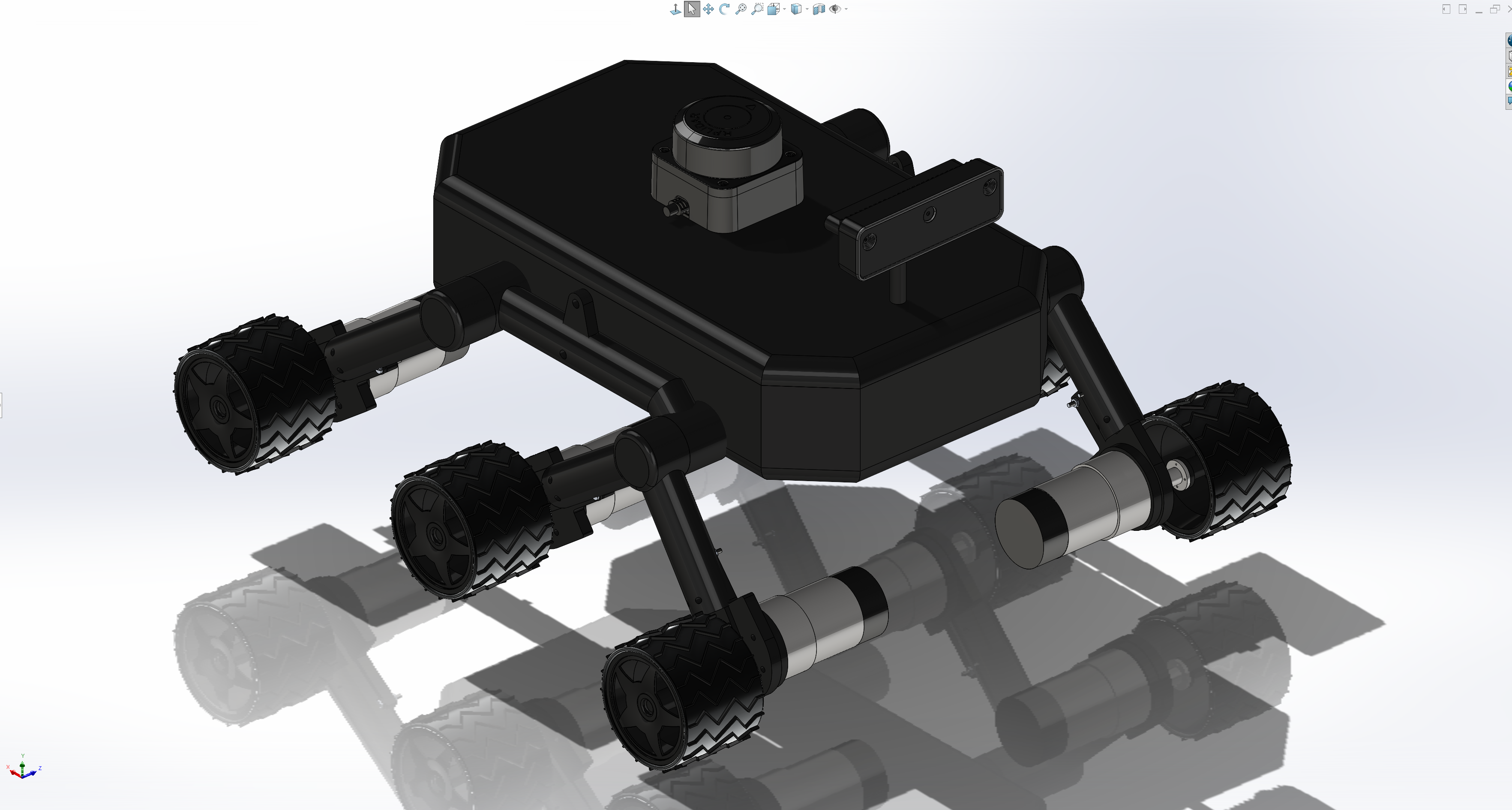
CAD is complete. Physical development is beginning, and a concept multi-robot visualization is in progress.
 EMERGENCEMONASH DEEPNEURON
AUTONOMOUS SYSTEMS / PLANETARY CONSTRUCTION
Exploring how decentralized robot swarms can build infrastructure together — and adapt when the mission changes.
EMERGENCE investigates a decentralized, homogeneous construction swarm for future lunar infrastructure.
One robot architecture. Multiple construction roles. The project brings excavation, transport, deposition and compaction into a shared workflow, with roads, landing pads and berms as target applications.
Our research focus is the integration of learned task allocation with that workflow — and, over time, validation on embodied robots.
CAD is complete. Physical development is beginning, and a concept multi-robot visualization is in progress.
Develop and evaluate shared-policy learning for adaptive role allocation across construction tasks.
Explore multi-robot construction, ISRU integration, maintenance and infrastructure expansion.
The platform combines perception, onboard compute and low-level control with a planned learned coordination layer.
Centralized training · decentralized execution
OAK-D Lite
360° 2D LiDAR baseline
Jetson Xavier NX
Current compute platform
STM32F446RE
Robot actuation
THE ROBOT PLATFORM
A homogeneous swarm uses the same robot architecture across the construction workflow. The platform is designed around mobility, material handling and compaction.
THE CENTRAL RESEARCH QUESTION
How can robots adapt their roles under failures and changing resource distribution, while continuing a shared construction mission?
Explore the validation approach ↗The intended workflow connects material movement with surface preparation. These are target capabilities, with physical testing still ahead.
Collect material using the arm and scoop.
Move material between collection and build areas.
Place material to form the intended structure.
Investigate vibratory compaction for surface preparation.
The roadmap separates the project’s present maturity from its proposed next steps and longer-term research direction. Stages are not dated commitments.
The robot architecture has reached completed CAD design.
The project is entering hardware development.
Training a reinforcement learning policy to control a single robot.
A multi-robot visualization communicates the intended system; it is not autonomous-results evidence.
Deploy the trained RL policy on a single robot for physical testing.
Develop toward multi-agent environments and shared-policy learning using PettingZoo and MARL.
Produce 2–3 additional robot units for physical multi-robot testing.
Explore coordinated workflows under failures and changing resources.
Investigate the connection to in-situ resource utilization.
Extend the research direction toward maintaining and expanding infrastructure.
The documented hardware baseline and proposed simulation stack support a progression from single-agent development to multi-agent research.
The project’s contribution is being explored through integration and embodied validation of learned allocation within a construction workflow.
Study role allocation under robot failures and changing resource distribution. Evaluation methods and measured results will be documented as research progresses.
Connect learning environments with the physical construction workflow. Concept visualization supports communication; it does not establish autonomous performance.
No measured performance results, deployed swarm capability or lunar qualification are claimed at this stage.
EMERGENCE is presented for robotics companies, space-industry partners, sponsors, researchers and engineering recruiters interested in the project’s development.
Potential areas for collaboration include hardware development, autonomy research, construction testing and support for the research platform.
Start with the project brief ↗Explore the project, discuss a research connection,
or consider supporting its development.